
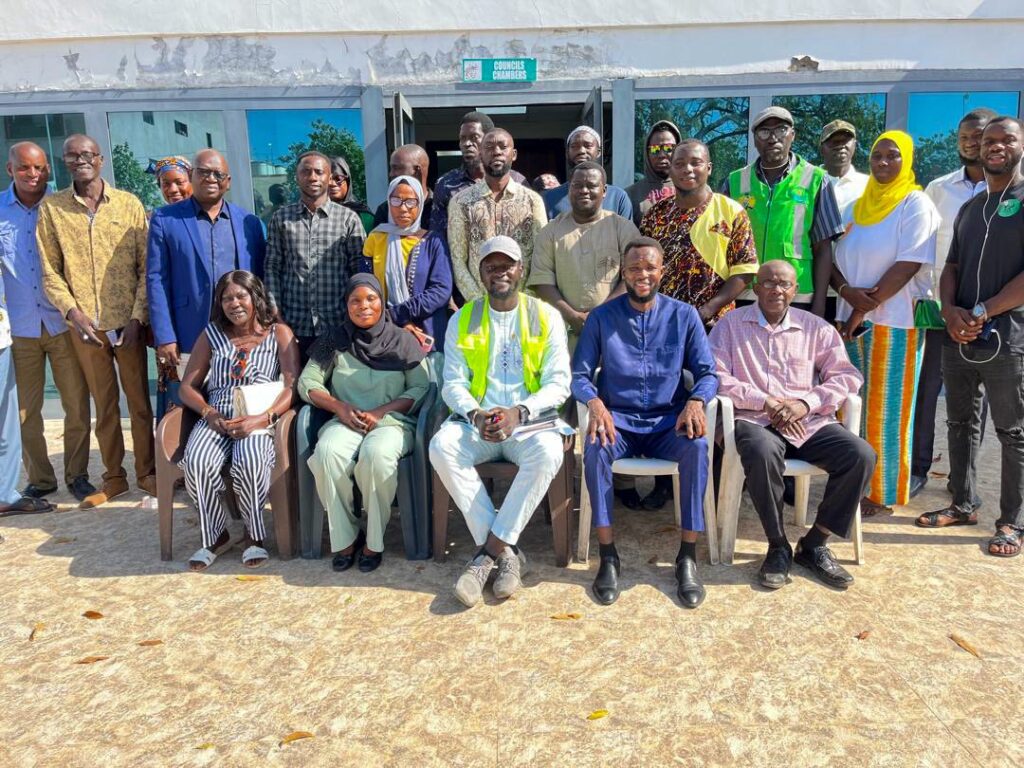
Earlier today, the Banjul City Council convened a high-level gathering at its Conference Room to mark the official launch of the report titled “Addressing Urban Heat Island (UHI) Challenges in The Gambia,” under the MRV for Climate Action Programme. The event brought together key national stakeholders and development partners in a collective effort to spotlight and tackle one of Banjul’s most pressing environmental threats: the intensifying Urban Heat Island effect.
Representing Her Worship Rohey Malick Lowe, the Lord Mayoress of Banjul, Deputy Mayor Hon. Abdou Aziz Dabakh Gaye delivered the Opening Statement. In his remarks, he welcomed all present and expressed appreciation for the collaborative spirit behind this initiative. He emphasized that the realities of climate change, rising sea levels, erratic rainfall, and recurrent heatwaves have only compounded urban vulnerabilities, particularly for coastal cities like Banjul. He further noted that the UHI effect, which results in significantly higher temperatures in urbanized zones due to a lack of vegetation and heat-retaining surfaces, poses a serious threat to public health, energy systems, and overall urban livability.
The report, which was informed by data collected from July to August 2025 in four communities and the BCC complex, revealed alarming findings. It recorded air temperatures above 36°C in areas like KG5 Mini Stadium, Sewage, and Crab Island, with surface temperatures on asphalt and concrete exceeding 51°C and, in some cases, peaking at 57°C. Household surveys and focus group discussions with 151 residents revealed deep concern over limited shaded areas, high heat exposure, and a lack of awareness regarding the causes and impacts of UHI. Communities expressed growing distress over health challenges, discomfort during peak heat periods, and rising electricity use for cooling needs.
The event was attended by Honourable Members of the National Assembly of Banjul, Hon. Modou Lamin Bah, Hon. Abdoulie Njai, senior government officials, BCC Hon. Ward Councillors and senior management, representatives of civil society and youth organisations, and a range of development partners including NovaSphere, the MRV for Climate Action Programme, and the Community of Practice (CoP). Also present were technical experts from the meteorology, energy, and urban planning sectors, who contributed to a robust panel discussion that followed the official launch. The panel offered key insights into practical pathways for addressing urban heat in The Gambia, including the need for enhanced urban greenery, inclusive planning, and climate-informed infrastructure design.
During the proceedings, the Deputy Mayor highlighted the importance of aligning Banjul’s urban development strategies with the national climate framework, including the Recovery-Focused National Development Plan (RF-NDP 2023–2027), the National Climate Change Policy, and the second Nationally Determined Contributions (NDC2). While these policies provide critical direction, he stressed that they must explicitly incorporate Urban Heat Island mitigation strategies to be fully effective.
The Deputy Mayor officially declared the report launched and called on all stakeholders to continue contributing meaningfully beyond the event. He underscored that collective leadership, community engagement, and evidence-based action are essential to ensuring Banjul becomes a cooler, more resilient city in the face of accelerating climate challenges.
